Is Your Fundraising Event Actually Worth It? How to Measure Event ROI
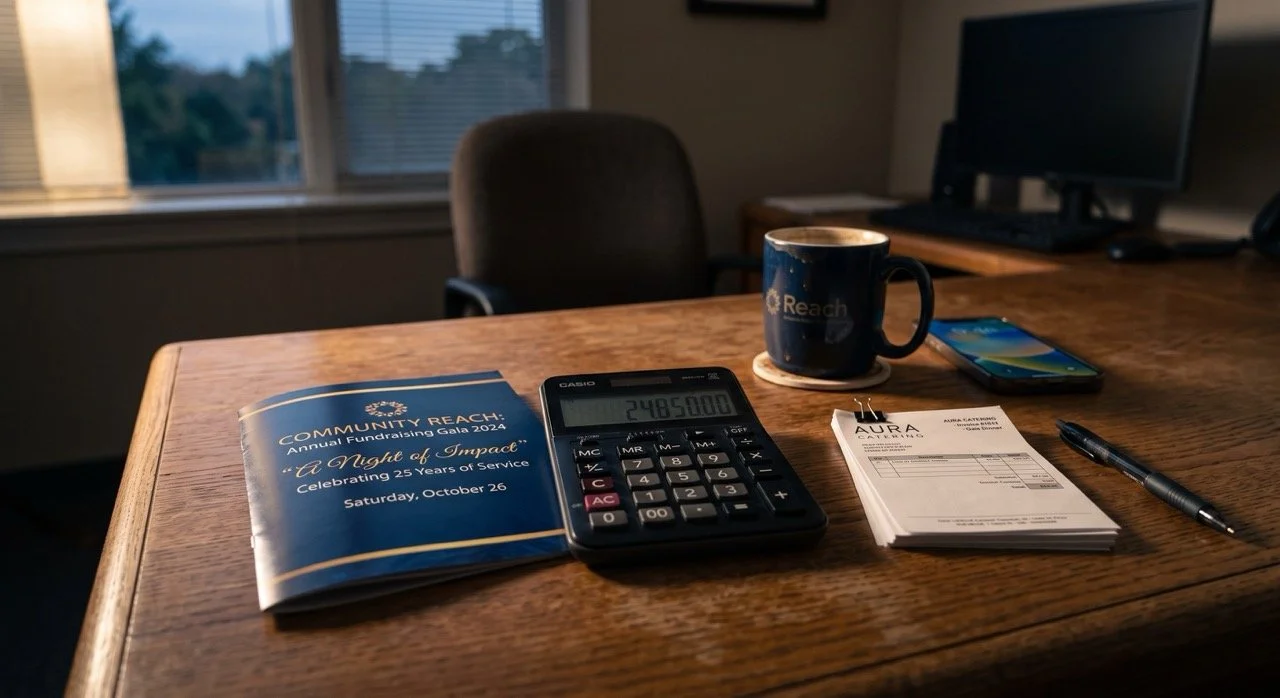
The gala goes beautifully. The room is full, the auction is loud, the board is thrilled, and the next morning someone announces that you raised eighty thousand dollars. Everybody exhales. And then, a few weeks later, once the invoices from the venue and the caterer and the AV company have all come in, the real number turns out to be a lot smaller than the one you celebrated. If you have ever had that quiet, sinking feeling looking at the final tally, you are not alone, and you are not doing anything wrong. Most of us were simply never taught to ask whether the event was actually worth it.
I want to walk through how to answer that question honestly, because the answer changes how you spend the most limited resource you have, which is your own time. I have sat where a lot of you sit. I spent years in ministry raising money, and the calendar was built around events the way the tides are built around the moon. We never stopped to run the math on whether the effort was paying us back. So let's do that together.
The Number That Actually Tells You If It Worked
The metric that matters here has a plain name: cost to raise a dollar. You take everything the event cost you and divide it by what you actually netted. If your gala grossed eighty thousand dollars and the direct costs added up to thirty-two thousand, you netted forty-eight thousand, and your cost to raise a dollar was about sixty-seven cents. In other words, it cost you sixty-seven cents to bring in each dollar you kept.
Is that good? Here is the context that makes the number mean something. According to research compiled by CauseVox, the average special event costs about fifty cents to raise a dollar, which works out to roughly a two-to-one return. So a sixty-seven-cent event is running a little below the pack. Now hold that next to how other kinds of fundraising perform. Major gifts, by the numbers from the Association of Fundraising Professionals, tend to cost only ten to twenty cents to raise a dollar, a five-to-one or even ten-to-one return. Charity Navigator reserves its best marks for organizations that spend under a dime to raise a dollar.
I am not telling you this to make you feel bad about your event. I am telling you because the comparison is the whole point. Events are one of the most expensive ways a nonprofit raises money, and once you see that in black and white, you can stop treating the gala as the crown jewel of your calendar and start asking it to earn its place.
The Costs You Are Not Counting
The sixty-seven cents above only counted the invoices. The venue, the food, the printing, the band. Those are the easy costs to see because someone hands you a bill. The costs that quietly wreck an event's return are the ones nobody invoices you for.
The biggest one is staff time. Think honestly about the last big event you ran. How many hours did you personally pour into it in the three or four months leading up to the night? Now add your executive director, your one part-time coordinator, the board members chasing sponsorships, the volunteers stuffing bags. It adds up fast, often to hundreds of hours across the team. If you put even a modest dollar value on that time, your real cost to raise a dollar climbs well past what the invoices showed. A gala that looked like it cost sixty-seven cents on paper can easily cost a dollar or more once you count the people.
Then there is the cost you can't see on any spreadsheet, which is opportunity cost. Every hour you spent on seating charts and silent-auction spreadsheets was an hour you did not spend sitting across a table from a major donor. That is the trade you are actually making, and it rarely shows up in the post-event report. When you measure event ROI well, you are really measuring whether this was the best possible use of the hours it consumed.
Running this math by hand every year gets old fast. A few good systems can do the counting for you and free you to focus on the donors instead of the spreadsheets.
Want to develop your fundraising skills? Take a look at my Claude Skills page.
Explore the Skills
Run the Whole Picture, Not Just the Night
So far we have looked at a single event in isolation, which is how most of us evaluate them. But the honest picture requires two more moves.
The first is to compare the event against your other channels using the same yardstick. This is where the handful of numbers that actually predict your future earn their keep. Line up your gala's cost to raise a dollar next to your direct mail, your online giving, and your major-gift work. If the event is your most expensive channel by a wide margin and it is also eating the most staff hours, that is not a small finding. That is a signal about where your energy belongs.
The second move is to look at what the event produced beyond the check written at the table. A good event does something a spreadsheet is bad at capturing: it puts you in a warm room with people who care about your mission. Some of those people are first-time guests brought by a friend. A few of them have real capacity to give at a level that would dwarf what they dropped in the auction. The question is not just "how much did we net," but "how many new relationships did this create, and what did we do with them." An event that nets a modest sum but introduces you to three future major donors may be worth far more than its cost-to-raise-a-dollar suggests, if and only if you actually follow up.
What an Event Is Actually Good At
Here is what I have learned, and it reframed events for me completely. An event is a poor fundraiser and a wonderful friend-raiser. The night itself is rarely where the money is. The money is in what happens next, when you take the momentum the event created and channel it into relationships.
That means the real return on your gala shows up in the people, not the check announced at the microphone. It is the new guest who lingered by the mission table, the loyal donor who brought two friends, the sponsor who is clearly capable of more. Your job in the days after is to move those people into a simple cultivation system so the connection does not evaporate by the following Tuesday. A promising guest who gets a real thank-you, a coffee invitation, and a look at the work can become a name in your major gifts pipeline within a year. That is where the true ROI of an event hides, and almost nobody measures it because it shows up twelve months later on a different line.
This is also why the post-event stretch matters more than the event. If you steward the people you met in the weeks that follow, the event pays dividends long after the tables are folded and stored. If you don't, you spent all those hours to rent a crowd for one evening and then let them walk out the door.
Where to Start
If you are staring down next year's event and wondering whether to keep it, here is what I would tell you to do, and none of it requires a consultant or a new budget line.
1. Run the real cost to raise a dollar on your last event. Add every invoice, then add an honest estimate of staff hours at a modest hourly value. Divide by what you netted. Sit with the number, even if it stings a little.
2. Compare it against your other channels. Put the event's cost to raise a dollar next to your other ways of raising money. You are not looking for a verdict of good or bad, just a sense of where this channel ranks so you can decide how much of your year it deserves.
3. Count the relationships, not just the dollars. Make a list of every new or high-capacity person the event put in front of you. That list is the real asset the night produced, and it is worthless if it sits in a drawer.
4. Build the follow-up before you build the event. Decide now how you will thank, cultivate, and steward the people you meet. If you cannot commit to the follow-up, the event will never earn back what it costs, no matter how lovely the night is.
When one of those relationships turns out to be a high-capacity donor thinking about a lasting gift, the conversation moves beyond this year's ticket. That is the kind of long-term generosity we help organizations build.
Interested in learning more about how a whole life insurance policy could benefit your nonprofit? Connect with a team member at Sage & Main.
Connect with Sage & Main
None of this means you should cancel the gala. For plenty of organizations, the event is where the community gathers, where the mission gets a face, and where next year's major donors first walk in the door. Those things are real and worth something. The shift I am inviting you to make is simply to stop measuring your event by the number you announce at the microphone and start measuring it by what it costs and what it creates. Once you see it clearly, you can decide with open eyes whether it is worth it, and how to make it worth more.
C.J. Bergmen is a pastor, licensed counselor, and fundraising strategist who helps organizations and generous individuals approach giving with honesty and long-term vision.