25 AI Fundraising Prompts Every Nonprofit Leader Should Save
Blackbaud reported that overall giving grew by about 4.3% year over year in 2025, but that growth was not evenly shared across the sector. Larger gifts and higher-capacity donors drove much of the increase, while smaller gifts lagged behind. That means many fundraisers are still facing a tough reality: raise more, personalize more, report more, and somehow do it with the same number of hours in the week.
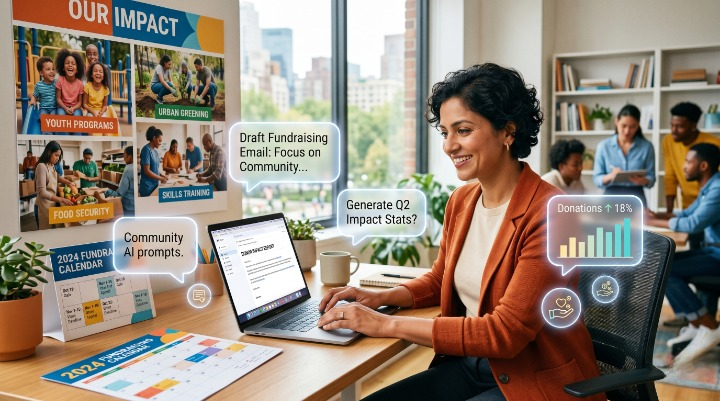
The right AI fundraising prompts can help nonprofit leaders move faster without sounding robotic. They can support fundraising strategy, sharpen donor communication, and improve donor engagement when used with care.
I like to think of AI as a brainstorming partner sitting beside you with a giant whiteboard. It can help you organize messy thoughts, test new angles, and draft a first version. But it should not replace your judgment, your relationships, or your mission voice.
A few tools you might use include ChatGPT prompts for fast drafting and Claude prompts for longer-form planning or message refinement. The skill behind both is prompt engineering, which simply means giving the AI clear instructions, context, audience details, tone, and desired output.
The biggest rule is simple: use ethical AI. Do not paste sensitive donor information into public tools. Check every fact. Keep real people at the center. AI can help build fundraising skills, but the fundraiser still brings the heart!
Prompts for Better Fundraising Copy
Strong writing still drives fundraising. Your donors need to understand the need, feel the urgency, trust your organization, and know exactly what to do next. AI can help you get there faster.
Try these prompts:
“Write three warm fundraising emails for donors who gave last year but have not given this year. Keep the tone hopeful, personal, and clear.”
“Create ten email subject lines for a campaign about [cause]. Make them specific, emotional, and under 50 characters.”
“Draft an appeal letter for [audience] that opens with a real-world problem, shares one story, and ends with a clear gift request.”
“Improve this paragraph for stronger fundraising copywriting while keeping the tone human and simple.”
“Write a personalized outreach message for a donor who cares about [program area] and gave [amount] last year.”
The best prompts include details. Instead of saying, “Write an email,” give the AI your audience, goal, tone, deadline, and call to action.
AI is also helpful when you need clearer mission messaging. For example, you can ask: “Explain our mission to someone who has never heard of us before, using plain language and one emotional example.”
You can also use AI to shape better impact stories. Feed it a short summary, then ask it to organize the story around the person served, the challenge, the solution, and the donor’s role. Just remember to protect privacy and get permission when sharing real stories.
Here are a few more prompts worth saving:
“Turn these program notes into a short case for support for a spring campaign.”
“Create five storytelling prompts our team can use when interviewing program staff.”
“Rewrite this donation page copy so the value of a $25, $50, and $100 gift feels concrete.”
Small changes matter. A stronger subject line can get someone to open the email. A clearer donation page can help them finish the gift. A warmer story can remind them why they care.
Better fundraising copy often starts with a better prompt, and a better prompt starts with knowing what you want your donor to feel, understand, and do next.
Need some help with fundraising prompts? Download my FREE guide below
Prompts for Understanding and Segmenting Donors
Fundraising gets easier when you stop talking to everyone the same way. A first-time donor, a monthly donor, a board member, and a major gift prospect should not all receive the same message.
This is where AI can help with donor segmentation. You can use it to sort ideas, build message frameworks, and identify patterns in non-sensitive exports from your database. Be careful with CRM data, though. Remove names, addresses, emails, and other private details before using AI.
Try these prompts:
“Based on these giving patterns, suggest five donor groups we could use for year-end messaging.”
“Create three donor personas for our nonprofit: a first-time donor, a loyal annual donor, and a potential major donor.”
“Review this anonymized giving summary and suggest useful data analysis questions our fundraising team should ask.”
“Create a message strategy for major donors who have supported our capital campaign but have not yet made a gift this year.”
“Write a cultivation plan for annual giving donors who have given three years in a row.”
Research continues to show that donor retention is one of the sector’s biggest challenges. The Fundraising Effectiveness Project reported that total charitable dollars grew in 2025, but many nonprofits still face pressure around donor participation and retention.
AI can help you respond with more personal stewardship. For example:
“Create a 6-month monthly giving welcome series for new sustainers.”
“Write a thank-you email for recurring donors that explains how steady gifts create reliable impact.”
“Map a simple donor journey from first gift to second gift to long-term supporter.”
“Suggest five ways to improve donor retention after a first-time gift.”
These prompts do not replace a donor database or a real conversation. They help you think faster. I especially like using AI to create “next best message” ideas. For example, if someone gave to a food pantry program last December, AI can help draft a renewal message that connects back to meals, dignity, and community care.
The key is to bring the AI output back into your own voice. Add the donor’s real connection. Mention the campaign they supported. Include a specific update. That is what makes the message feel personal instead of pasted together.
When donor data is handled carefully, AI can help you see useful patterns and turn those patterns into thoughtful next steps.
Want to develop your fundraising skills? Take a look at my Claude Skills page
Prompts for Campaigns, Events, and Community Support
Campaigns have a lot of moving parts. You need the message, timeline, emails, social posts, board reminders, matching gift language, event details, and follow-up plan. AI is great at helping organize the chaos.
Start with campaign planning:
“Build a 6-week campaign plan for [campaign name], including audience, message, channels, deadlines, and staff roles.”
“Create a simple fundraising calendar for the next quarter with weekly donor communication ideas.”
“Plan a year-end fundraising campaign with three emails, five social posts, one board reminder, and one donor thank-you message.”
Year-end giving deserves special attention because it often carries a large share of annual revenue. Blackbaud’s 2025 giving analysis found that year-end performance helped power overall growth for many organizations.
You can also use AI for channel-specific planning:
“Write ten social media fundraising posts for a campaign about [cause], with a mix of story, urgency, gratitude, and direct asks.”
“Create a toolkit for peer-to-peer fundraising participants, including sample posts, texts, and thank-you messages.”
“Draft a run-of-show and donor follow-up plan for event fundraising.”
“Create a one-page guide for board fundraising that gives board members simple ways to invite support.”
“Write a short recruitment message for volunteer recruitment tied to our upcoming campaign.”
Community partnerships can also benefit from stronger prompts. Ask AI to draft a sponsorship menu for corporate sponsorships, including benefits at each level. Or ask it to write a short campaign blurb about matching gifts so donors understand how their gift can go further.
One of my favorite uses is turning a rough idea into a usable project plan. You might type: “We want to raise $50,000 in six weeks for summer meals. We have email, Facebook, Instagram, board members, and one local business match. Build a plan.” The first draft will not be perfect, but it gives your team something to react to. That saves energy!
Save the Prompts, Then Add the Human Touch
AI can also help with important fundraising tasks that are easy to delay. Use it for grant writing outlines, reactivation messages for lapsed donors, and better stewardship plans after a campaign ends.
You can ask it to draft heartfelt thank-you notes, organize prospect research questions, and write friendly pledge reminders that do not feel pushy. You can also use fundraising automation to schedule the right message at the right time, as long as your team reviews the content and keeps it personal.
For broader nonprofit marketing, AI can help repurpose one campaign story into an email, a donor update, a social caption, and a board talking point. It can also generate fresh nonprofit fundraising ideas when your team feels stuck.
The best results come from pairing AI with clear fundraising goals. Tell the tool what you are trying to accomplish. Are you trying to renew 100 donors? Secure 20 new monthly gifts? Book five major donor meetings? Raise $25,000 by June 30? The clearer the goal, the better the prompt.
Donors are also paying attention to how nonprofits use AI. Fidelity Charitable has highlighted donor concerns around trust, transparency, and responsible AI use in philanthropy. That means fundraisers should use AI openly, carefully, and always in service of stronger human connection.
So save these prompts. Edit them. Make them your own. Share them with your team. AI will not replace the joy of a real donor conversation, the power of a great story, or the trust built through consistent follow-up. But it can help you get to those moments with less stress and a lot more confidence.
AI can give you a strong first draft, but your mission, relationships, and donor trust are what turn that draft into real fundraising momentum.
Interested in learning more about how a whole life insurance policy could benefit your nonprofit? Connect with a team member at Sage & Main